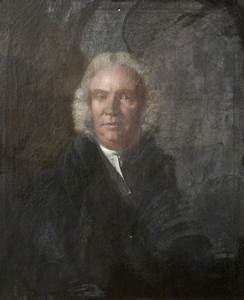
The isolated church has had many notable personages. Its vicar from 1732 to 1767 was Theophilus Evans, the man who first discovered the health-giving properties of the local sulphur spring waters that started Llanwrtyd Wells on the route to becoming a spa town.
Theophilus was of noble birth – Grandson 21 times removed of Edward 1st of England (Longshanks) on one side of the family and the ancient Welsh Princes on the other. He wrote many books in both Latin and Welsh. The most widely read was “A History of Primitive Ages” – a must read for school children during the 19th and 20th centuries an often quoted at the various Eisteddfodau throughout that period.
The curate under Theophilus between 1740 and 1743 was a young William Williams, later to find fame as William Williams Pantycelyn. He was destined by his local farming family to become a doctor, William Williams had heard Hywel Harris preaching Methodism locally in 1738 and in 1743 left the Church of England (as it was then) to become a Methodist.
Or more precisely, the people of Llanwrtyd Wells petitioned to have the young man expelled for his interest in the new dissenting branch of religion. He was in effect forced (both by his own conviction and local disapproval) to become a travelling preacher in the Hywel Harris mode. His uncertainties and strong faith prompted him to draft the original Welsh language words of what became ‘Guide Me, Oh Thou Great Jehovah’, which of course every good Welshman knows off by heart , when coupled to the tune Cwm Rhondda composed by John Hughes later in 1907 and translated into English by a Peter Williams.
William Williams wrote over 800 hymns as an itinerant dissenting Methodist but is best remembered for this one. Interestingly he never renounced his Anglican beginnings.
The son-in-law of Theophilus Evans, Hugh Jones followed Theophilus as a vicar of the Old Parish church in the late 18th century. Not much is known about him as a priest but, is more famous for being the Great Uncle 6 times removed of Sophie Rhys-Jones the Countess of Wessex.
Rev. Thomas Howell vicar at St David’s in the 16th century was the son in law of Thomas Huet Cantor Menevia, who in 1567, translated the Book of Revelations of St. John into Welsh
Captain John Lloyd 1748 – 1818 of the East Indian Company of Dinas House near the church. He would have attended the circulating school in St David’s church, Lloyd, joined the East India Company as an “apprentice to the ships surgeon” and over a 15 year period worked is way up to the rank of Captain He was an intrepid sailor who was captured several times during his many exploits to the Middle and Far East and retired having made fortune – some £5 million in today’s money.
A marble plaque near the pulpit was erected to his memory in 1823, recording his life and adventures.
D C (Christmas) Williams (1871-1926) a composer of some regard with his works being presented at the several Eisteddfodau in the late 19th and early 20th centuries. He had numerous arrangements published but his most successful was “Welsh Airs” arranged for Male Voices published in 1913.
John Thomas, (1839-1921) a composer known as ‘Llanwrtyd, his bardic name, he was prominent at Eisteddfodau through the 19th century and an accomplished conductor.
Sir Daniel and Lady Davies of Pen-y-Banc had a window near the font dedicated to them both in 1987. Sir Daniel was a Fellow of the Royal Medical Society and in 1938 he became physician to King George V1 and later to Her Majesty Queen Elizabeth

Pastor James Rhys (Kilsby) Jones (1813- 1889) commenced his congregational pastorate in Leominster I 183. Amongst others places, he was a pastor in Rhayader and later Caebach Chapel, Llandrindod Wells. He instigated the building of Christ Church Chapel. Jones preached in Welsh or English and had a reputation as a lecturer with a biting wit. He also was a man of literary talent translating eminent works from English to Welsh and Welsh to English. He lived in Glenview (later called Kilsby House) Llanwrtyd for the latter part of his life. His home can be clearly seen from the Graveyard.
 St David's Old Church, Llanwrtyd Wells