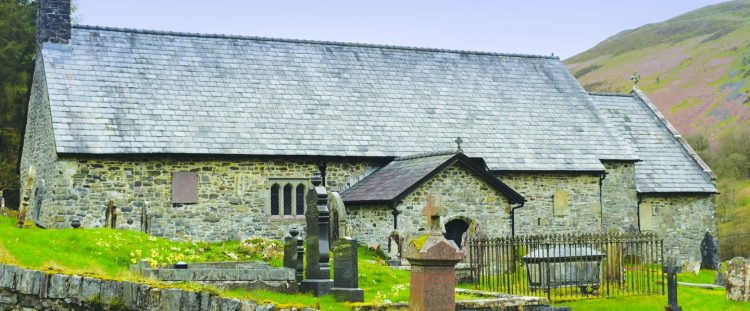
The Old Parish Church is the oldest of the church buildings in the Ministry Area and beyond, it sits in idyllic isolation overlooking the river Irfon, exuding peace and tranquillity – nestled amongst the hills.
St. David’s a grade 11* listed church, was once the centre of Llanwrtyd and would have been surrounded by cottages and farms some 200 years ago. There is little evidence of them today apart from Dinas and Dinas Mill two examples of beautiful 17th and 18th century large cottages located within 100metres of the Church. It was the Parish Church until St. James’ was built in 1896, as a Mission church to serve the needs of the growing community.
The present church has a recorded history spanning 1000 years or more. The site was reputed to have been chosen much earlier by St. David himself for the promulgation of the Christian faith following the hugely significant synod at Llanddewibrefi in 519 AD. – Hallowed ground indeed. The early church would have been of wood and waffle structure with earth floors, very basic but undoubtedly a deeply spiritual place.
In 1164, Lord Rhys, the then owner of a vast swage of this part of Breconshire, gave the hills behind the church to the new Cistercian monastery at Strata Florida and the church remained with the monks until 1535. Of particular note is that in 1569 Queen Elizabeth 1st presented a Silver Chalice to the church which bears the name “Llanwortyd”, it should have of course been spelt Llanwrtyd..
The Church spans four periods of architecture, excepting the original structure, the window near the pulpit is 12th century; the other windows are 15th century; the Chancel added in Norman times period. The porch was built in the 16th century; previously entrance to the Church would have been through a door at the West end, the outline of which is visible today behind the larger than life statue of St. David.
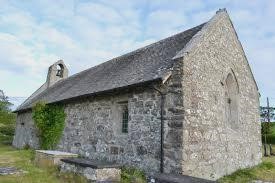
Example of what St. David’s may have looked like prior to the sanctuary and porch being added
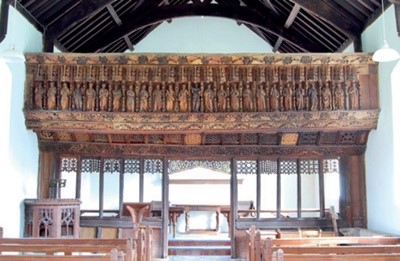
Uncovered only in 1968 by roofing contractors, is a stone mural staircase the entrance to which is located in the South wall, access is between two rows of pews. During the latter middle ages (c.1300- 1500) many churches were furnished with a rood screen. In the 15th century many rood screens were surrounded by a gallery known as a rood loft, thus St David’s would have had its own rood screen and loft. The rood comprised scenes of the crucifixion beautifully carved and painted with flanking figures of the Virgin Mary and St Peter. Unfortunately it was destroyed during the latter part of the Reformation around 1600 AD, but would have looked very similar to the one below.
18th Century Circulating Schools.
The West end of the Church (where the wooden carving of St. David stands) has a raised section of flooring that would have been portioned off to separate it from the church. There is evidence in the North and South walls of where the partition would have been. This area of the Church was used as a “circulating school”
In an age when there was no compulsory education, when the vast majority of working class people could neither read nor write, Griffith Jones created a system of schooling that by the time of his death in 1761 had taught almost 200,000 people to read.
Jones, arguably more than anyone else, helped to make Wales into a literate and literary nation.
Griffith Jones was born in Carmarthenshire in 1683. He was educated at Carmarthen Grammar School and was ordained into the Church of England in 1708. After early curacies in places like Penbryn (Cardiganshire) and Penrieth (Pembrokeshire), he became curate and master of the Society for the Promotion of Christian Knowledge School (SPCK) in Laugharne.
What Griffith Jones created was a series of schools that would rotate or circulate around the rural parishes of Wales, mainly in the winter months when farm work was relatively slack. The schools would stay in one place for approximately three months and then move on to another location. Dozens of men, women and children flocked to the schools where they used the Bible both as a means of instruction and as a training manual or reading book.
Theophilus Evans a Vicar of this church and referred to in the section below was a keen supporter of the circulating schools and whenever possible contributed to spreading the word of God.
Heating the church.
During the Victorian era and well into the 20th century St. David’s benefited from a unique heating system – the Gurney Stove.
Sir Goldsworthy Gurney invented a new type of warm-air stove which he patented in 1856. He sold his invention to the Warming and Ventilation Company. The company name together with Gurney encircles the crown embossed circular lid and can be clearly identified.
By 1899 over 10,000 Churches schools and government buildings were heated by a Gurney. Other lager examples can be seen in St. Paul’s, Hereford, Chester and Ely Cathedrals and Tewkesbury Abbey.
It’s unclear when the stove was last in use. The chimney although still insitu has been capped off. Given that there’s no electricity in the Church the congregation have often asked about it being brought back into operation- the winters in Llanwrtyd are often cold and wet!.
 St David's Old Church, Llanwrtyd Wells